25 Oct '12

IDEO Chicago Make-A-Thon

Hack, Make, prototyping, serious play

By Annette Ferrara

Hacking and building new ways for Chicagoans to eat, move, and learn.

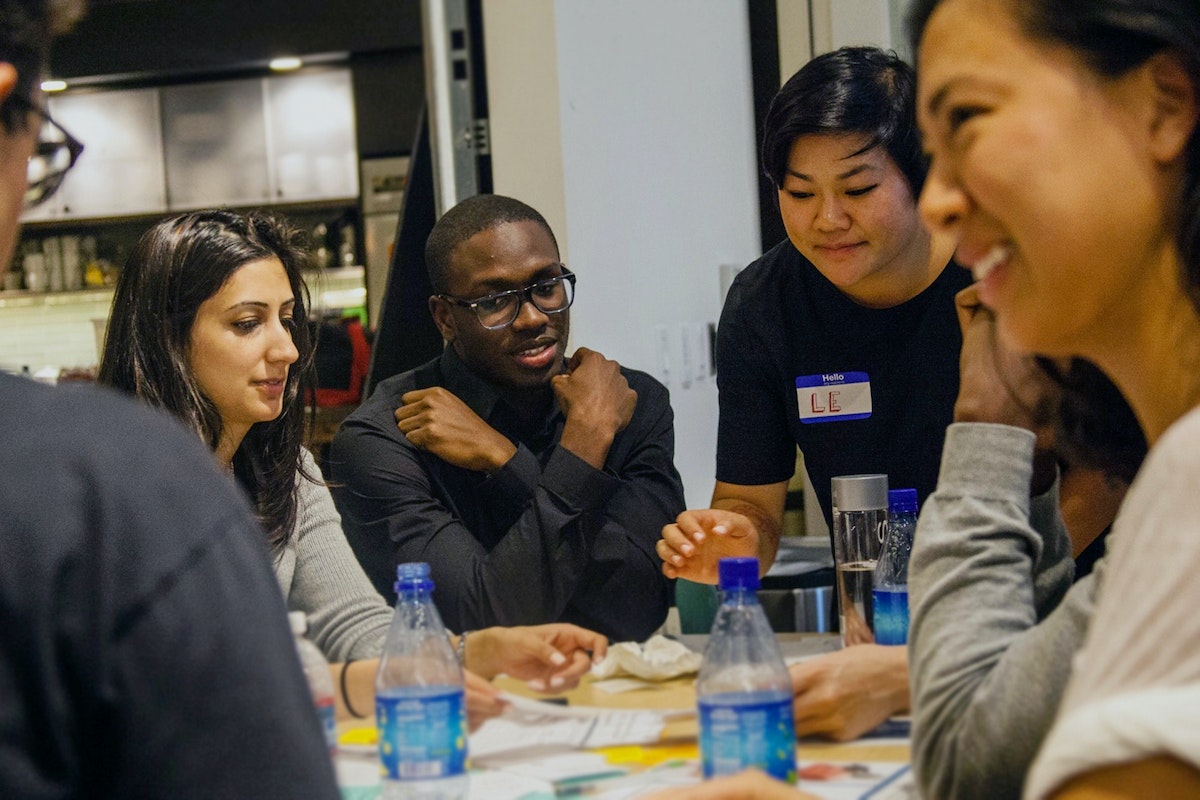
Inspired by the IDEO Make-a-thon prototyped in the London studio, our Chicago studio launched the first IDEO Make-a-thon in the US as part of Chicago Ideas Week—a city-wide celebration of “sharing ideas, inspiring action, and igniting change to positively impact our world.”

Our goal: use design thinking and rapid prototyping to hack and build solutions to some of the big gnarly problems that Chicago faces around healthy food, urban cycling, and public education. In partnership with Feeding America, Alta Bicycle Share, and Chicago Public Schools, we chose three themes for our day-long maker fest: “Eat,” “Move,” and “Learn.” Together we created three multi-disciplinary Make teams, composed of IDEO designers, outside experts, and special guests. (more…)

With the passing of IDEO co-founder Bill Moggridge, we have been reflecting on the ways he has influenced our lives and made the world a better place.  Bill has had an enormous impact on the field of interaction design and professed the importance of making interactions delightful.

For IDEO Labs, we wanted to do a tribute to him in a very IDEO Labs kind of way.  Perhaps one of the most iconic objects Bill designed was the GRiD Compass, the world’s first laptop computer.  Bill’s design was the original clamshell design that all current laptops have descended from.  We wondered if we could use a GRiD as a way to collect stories about Bill from around the office. (more…)

02 Jul '12

Bluetooth 4.0 as a prototyping tool

Arduino, Hack

By Jimmy Chion

how our Bluetooth platform works

When the iPhone 4S launched in October of last year, it shipped with a feature that has yet to be fully utilized. That feature, Bluetooth 4.0 (also known as Bluetooth Low-Energy) is also in several new Apple products including the iPad 3 and MacBook Air. It is not unlike previous versions of Bluetooth, but it has some notable advantages that make it ideal for certain applications: (more…)

Test-driving the usability of a food-tech startup’s new API.

When the Food Genius team moved into an empty project space at IDEO Chicago to become our first Startup-in-Residence, we were cautiously optimistic. This co-locate-with-startups thing was new to both of us. Would they like us? Would we like them? It was like meeting our first college roommate all over again, only this one had a complex algorithm that tracked and classified more than 14 million restaurant menu items. Swoon! We love nerds who design with data. (more…)

Mixing makers, hackers, designers, and OpenIDEOers in IDEO’s London studio

Way back in December, some of us in the IDEO London studio started talking in a pub about some of the ideas arising out of OpenIDEO and its challenges for social good.

We wondered: How could we help the digital community build out more of these winning tech and design solutions? What would happen if we got passionate designers, hackers, and digital community members in a room with no distractions one weekend, all working towards creating physical & digital prototypes for social good? And, could we all play around with Arduino and the 3-D printer while we were at it?

Originally we thought of doing a hackathon. Then we decided to push the concept to its next iteration. How could we bring together multidisciplinary weekend project teams—not just software engineers and digital designers, but also industrial designers, architects, and problem solvers from different backgrounds? Could we create a new kind of design-driven collaborative event? Inspired by IDEO’s own maker culture, the DIY community at Maker Faire, and Silicon Valley hackathons, we decided to experiment with the concept. We called this prototype event a “Make-a-thon.”

The result was a unique London pop-up event that produced some truly original concepts and meaningful digital and physical prototypes. We hosted about 60 makers and hackers in the IDEO London studio—including 1/3 IDEOers and 2/3 UK creative community members. We used EventBrite to keep track of invitations and had a waiting list of about 65 people. Here’s what we made in a 1.5 days—and what we learned.

(more…)